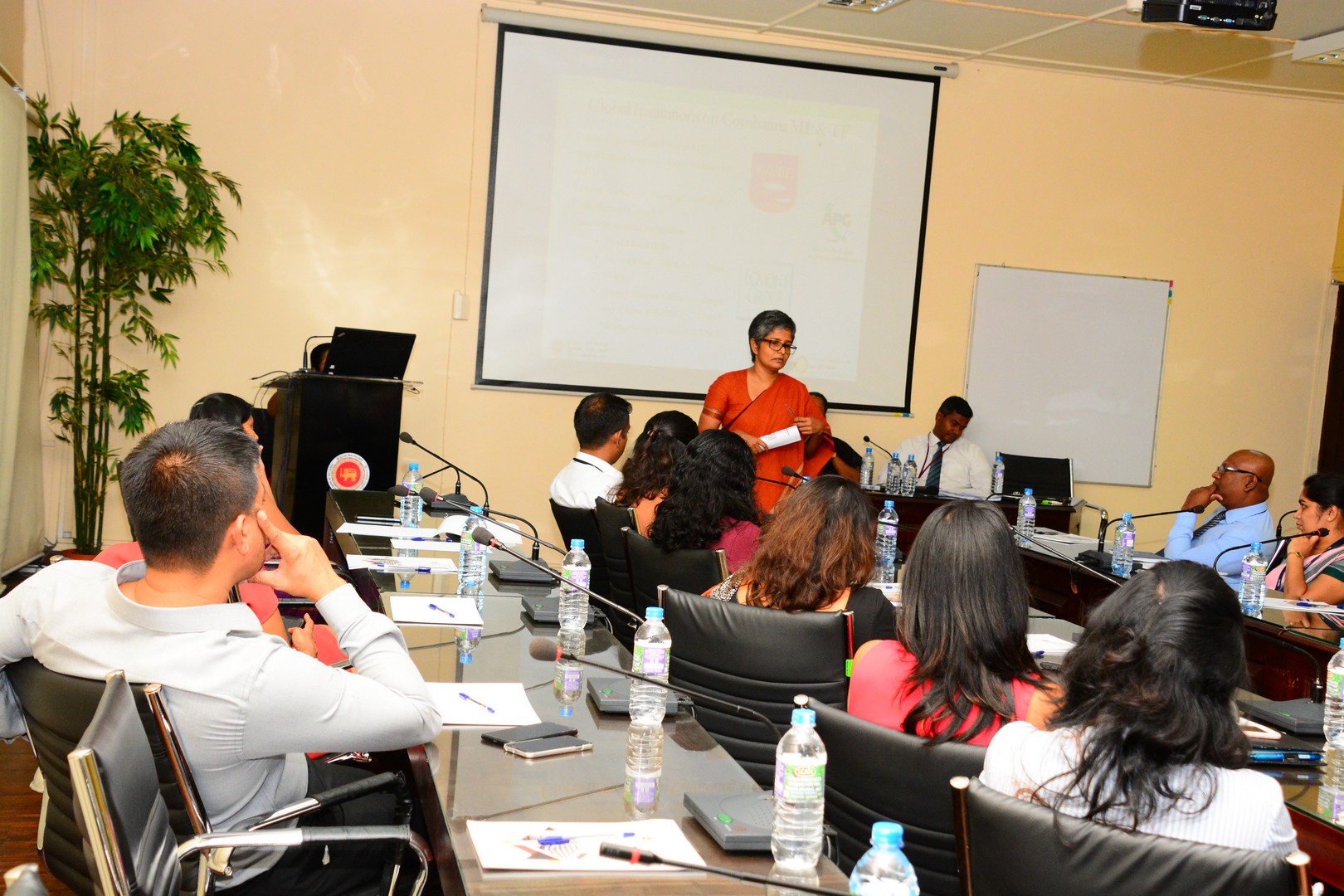
Description
In terms of subsection (i) of Designated Non-Finance Business in Section 33 of Financial Transactions Reporting Act No. 06 of 2006 (FTRA), gem and jewellery dealers when they engage in any cash transaction with a customer, equal to or above the prescribed threshold they are required to comply with Anti Money Laundering and Countering the Financing of Terrorism (AML/CFT) measures. The Rule No. 9(2)(b) of the Designated Non-Finance Business (Customer Due Diligence) Rules, No. 1 of 2018 (CDD Rules for DNFBPs) prescribed the threshold as equivalent to or above United States Dollars 15,000 in Sri Lankan Rupees or in any foreign currency.
Compliance Officer Appointment
In terms of Section 14 of the Financial Transactions Reporting Act, No. 6 of 2006 (FTRA), every Institution shall be required to appoint a Compliance Officer who shall be responsible for ensuring the Institution’s compliance with the requirements of the FTRA.
Further, under Rule No. 41 of the Designated Non-Finance Business (Customer Due Diligence) Rules, No. 1 of 2018, gem and jewellery dealers are required to appoint a senior management level officer as the CO to handle AML/CFT related matters within the entity.
All appointments or changes of the CO must be notified to the Director, FIU by submitting the ‘CO Declaration Form’.
The duly completed CO Declaration Form should be forwarded to the FIU via email or post;
Address:
Director,
Financial Intelligence Unit,
Central Bank of Sri Lanka, Colombo 01
Email: fiudnfbp@cbsl.lk
Acts
Convention on the Suppression of Terrorist Financing Act, No. 25 of 2005
Convention on the Suppression of Terrorist Financing (Amendment) Act, No. 41 of 2011
Convention on the Suppression of Terrorist Financing (Amendment) Act, No. 3 of 2013
Convention on the Suppression of Terrorist Financing (Amendment) Act, No. 18 of 2026
Prevention of Money Laundering Act, No. 5 of 2006
Prevention of Money Laundering (Amendment) Act, No. 40 of 2011
Prevention of Money Laundering (Amendment) Act, No. 16 of 2026
Financial Transactions Reporting Act, No. 6 of 2006
Financial Transactions Reporting (Amendment) Act, No. 17 of 2026
Regulations
Prevention of Terrorism (Proscription of Extremist Organizations) Regulations No. 1 of 2019.
Order under regulation 75(1) of the Emergency (Miscellaneous Provisions and Powers) Regulations No. 1 of 2019
Suspicious Transactions (Format) Regulations of 2017
Financial Transactions Reporting Regulations No. 1 of 2008
Rules
YEAR 2018
- Designated Non-Finance Business (Customer Due Diligence) Rules, No. 1 of 2018. – Extraordinary Gazette No 2053/20, January 10 of 2018
Directions
Circulars
YEAR 2026
- Circular 03/2026 – Application of Enhanced Due Diligence (EDD) measures and countermeasures in respect of jurisdictions identified by the Financial Action Task Force (FATF) as higher-risk jurisdictions
- Circular 01/2026 – Review and Update of Institutional Risk Assessments in line with the National Money Laundering, Terrorist Financing and Proliferation Financing Risk Assessment 2024/25
Guidelines
YEAR 2019
- Guidelines on Identification of Politically Exposed Persons, No. 03 of 2019
- Guidelines for Designated Non-Finance Businesses on Identification of Beneficial Ownership, No. 02 of 2019
- Guidelines for Designated Non-Finance Businesses on Suspicious Transactions Reporting, No. 01 of 2019
YEAR 2018
Financial Institutions & Designated Non-Finance Businesses
- Guidelines on Implementing United Nations (Sanctions in relation to Iran) Regulations No. 1 of 2018, No. 7 of 2018
- Guidelines on Implementing United Nations (Sanctions in relation to Democratic People’s Republic of Korea) Regulations of 2017, No. 5 of 2018
Designated Non-Finance Businesses
Appointing a Compliance Officer
In terms of Section 14 of the Financial Transactions Reporting Act, No. 6 of 2006 (FTRA), every Institution shall be required to appoint a Compliance Officer who shall be responsible for ensuring the Institution’s compliance with the requirements of the FTRA.
Further, under Rule No. 41 of the Designated Non-Finance Business (Customer Due Diligence) Rules, No. 1 of 2018, gem and jewellery dealers are required to appoint a senior management level officer as the CO to handle AML/CFT related matters within the entity.
All appointments or changes of the CO must be notified to the Director, FIU by submitting the ‘CO Declaration Form’.
The duly completed CO Declaration Form should be forwarded to the FIU via email or post;
Address:
Director,
Financial Intelligence Unit,
Central Bank of Sri Lanka, Colombo 01
Email: fiudnfbp@cbsl.lk
Conducting Customer Due Diligence
In terms of Part II of the CDD Rules for DNFBPs, gem and jewellery dealers when a customer/beneficial owner engages in financial transactions in Sri Lankan Rupees or in any foreign currency equivalent to or above USD 15,000, are required to conduct CDD measures.
The following minimum information should be collected to conduct CDD on a customer/beneficial owner;
- the full name;
- permanent residential or mailing address;
- occupation, name of employer, business or principal activity;
- an official personal identification number or any other identification document that bears a photograph of the customer or beneficial owner such as the national identity card, passport or driving license;
- date of birth;
- nationality;
- source of funds;
- purpose of transaction;
- telephone numbers (residence, office or mobile).
Once collected the above information, the identity of the customer should be verified. The gem and jewellery dealers are required to verify the identity of the customer using reliable, independent source documents, data or information (10(a) of the CDD Rules for DNFBPs).
Gem and jewellery dealers shall verify the identity of the customers and the beneficial owner before, or during, the course of entering into a business relationship.
Further, information obtained on point (d) of the above should be verified by requiring the customer or beneficial owner to furnish the original document and make a copy of the said document.
Sanctions Screening
As a member of the United Nations, Sri Lanka is obliged to comply with the Resolutions issued by United Nations Security Council (UNSC). As per the United Nations Act No 45 of 1968, the Minister of Foreign Affairs has issued the following Regulations promulgating such resolutions of the UNSC related to Terrorist Financing and Proliferation Financing.
- The United Nations Regulations No. 01 of 2012
- The United Nations Regulations No. 02 of 2012
- United Nations (Sanctions in relation to Democratic People’s Republic of Korea) Regulations of 2017
- United Nations (Sanctions in relation to Iran) Regulations No. 1 of 2018
Accordingly, Designated Non-Finance Businesses and Professions (DNFBPs) have the obligation to screen their customers and implement financial restrictions/ financial sanctions by freezing all funds, financial assets and economic resources owned or controlled directly or indirectly by individuals or entities designated by the UNSC or persons acting on their behalf.
Record Keeping
Every gem and jewellery dealer shall maintain the relevant records including any accounts, files, business correspondence and documents relating to transactions, in particular, obtained during the CDD process, documents used to verify the identity of customers and beneficial owners, and results of any analysis undertaken, in compliance with sections 5 and 6 of the Act.
The records so maintained and retained shall be up-to-date.
Every gem and jewellery dealer shall retain the records for a period more than six years. Where any record is subject to an on-going investigation or litigation or required to be produced in a court of law or before other appropriate authority such record shall be retained until such time the non-finance business is informed by the relevant authority that such records are no longer required
Reporting Suspicious Transactions
A suspicious transaction is a completed or an attempted transaction where there are reasonable grounds to suspect that the transaction is related to a money laundering (ML), terrorist financing (TF) or an unlawful activity.
A Suspicious Transaction Report (STR) is a report submitted to the FIU under the Section 7 of the FTRA by any Institution regarding a suspicious transaction. Institution means, any person or body of persons engaged in or carrying out any finance business or designated non-finance business.
An institution shall submit an STR as soon as practicable, after forming the suspicion or receiving information, but no later than two working days thereafter.
The FIU provides online access to certain sectors for submitting STRs. Other institutions may submit STRs manually in accordance with the Suspicious Transactions (Format) Regulations of 2017.